Cancer data is buried in the attachments.
Before 2023, the normal way to share a cancer dataset was to attach a spreadsheet to the paper. Those files still exist, but no catalogue lists them. We counted every one across 26,228 NCI-funded open-access papers, then opened all 25,411 attachments of the 4,759 spreadsheet papers: 9,543 are real datasets.
How we counted
Two independent methods, and they agree.
- 01Census. Europe PMC's search finds every NCI-funded open-access paper from 2016 to 2022 that has supplementary files and no text-mined accession for GEO, SRA, dbGaP, EGA, ArrayExpress, PRIDE, BioProject, MetaboLights, PDB or GenBank. We read each paper's full text and listed its attachments by filename, size and caption. 73,795 attachments in 25,138 readable papers. Nothing downloaded.
- 02Sample. Four random samples of 300 papers each (glioblastoma, breast, colorectal, leukemia) from that population. Every attachment downloaded, every spreadsheet, CSV, Word and PDF file opened. A file counts as a dataset if its largest table has at least 50 rows and 3 columns, or at least 1,000 rows. Peer-review letters, reporting summaries and figures are excluded automatically.
- 03Re-examination. 90 of the classifier's decisions were re-examined file by file (with the AI assistant, not blind; verdicts published). All 60 files it called datasets were real data tables; every table it missed was under 50 rows. A blind human check is the next step.
- 04Package and list. Eight datasets from CC BY papers were packaged unmodified with DataCite-style metadata, ready for deposit in an NIH-recognized repository (nothing uploaded yet). All 9,543 datasets found in the full census were written into a source file in the exact 27-column schema the Index of NCI Studies pipeline already loads for its curated sources.
| Cancer (random sample of 300, GEO papers excluded) | Analysed | Papers with a dataset | Share | CC BY / CC0 |
|---|---|---|---|---|
| Glioblastoma | 271 | 53 | 19.6% | 41 |
| Breast cancer | 271 | 51 | 18.8% | 46 |
| Colorectal cancer | 273 | 53 | 19.4% | 47 |
| Leukemia | 261 | 45 | 17.2% | 33 |
| Pooled | 1,076 | 202 / 1,076 | 18.8% | 167 |
Datasets found so far
Try the working tool: search all 15,458 buried spreadsheets, filter by year, journal or license, paste a PMC ID to see what is buried in one paper, and open any file directly from PubMed Central.
The sample view: 462 dataset files from the four 300-paper samples (the full 9,543 are in the tool above), each with an automatically generated description (201 papers), after excluding papers that carry a GEO accession. Descriptions are generated from the file itself and are meant to be readable by someone who is not a data scientist. Sizes are the largest table in the file.
| Dataset and source paper | What it looks like | Rows | Cols | License |
|---|
Rescued tables put back to work
Three glioma tables rescued from the glioblastoma sample, none listed in any catalogue, joined into analyses none of the source papers did. Left: two TCGA-derived tables from different papers, pooled to 1,037 patients, reproduce the known IDH survival split, which validates the data. Middle: a cross-table comparison that exists only because two buried files were put side by side. Right: a 121-patient hospital cohort, shown descriptively; its grouping (IDH or TERT mutated vs neither) is not the same as the IDH split and the numbers are small. This file does have a publisher-minted Figshare DOI, but that record names no NCI grant and NCI's index does not list it. Code and outputs are in the repository under demo/.
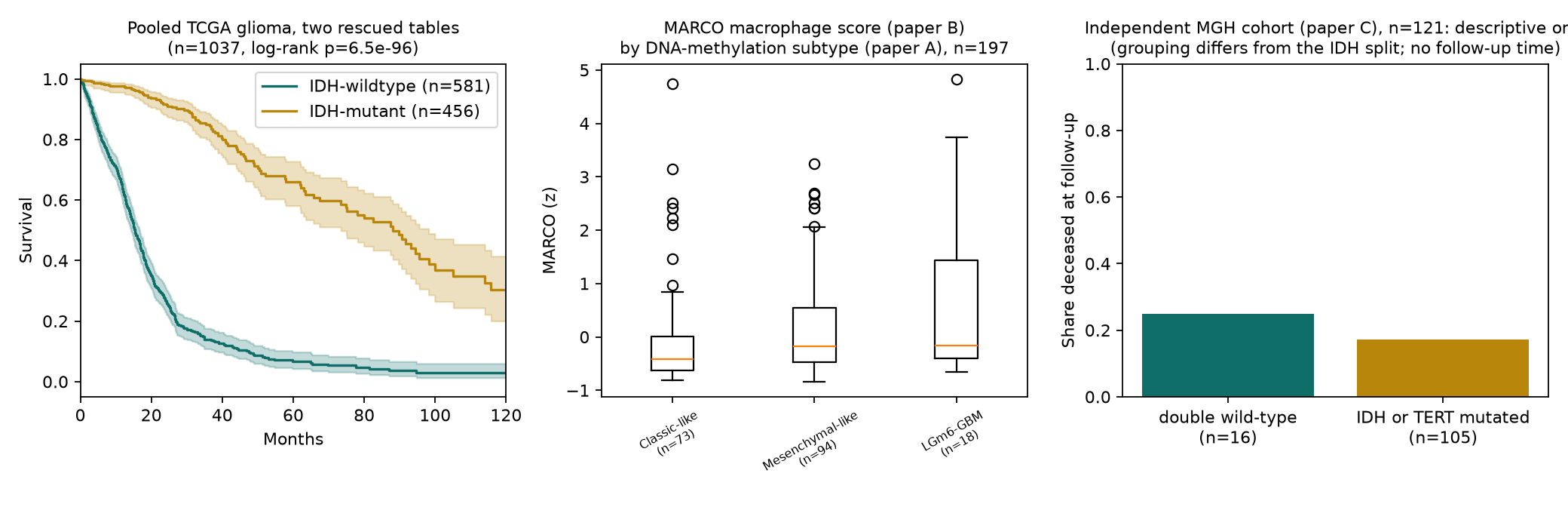
Verified patient-level tables across the four samples describe about 4,400 patient records, roughly 500 of them from institutional cohorts not in TCGA, GEO or dbGaP. Two of the three tables above are curated slices of public TCGA data, so the survival result is a reproduction of known biology, not new evidence.
Where the buried data is: by journal
The census by journal, NCI-funded open-access papers 2016–2022 with supplementary files and no repository accession. Journals whose authors most often attach data are the ones with the most to rescue. Top 15 by spreadsheet files; the full table of 103 journals is in the repository.
| Journal | Papers | With a spreadsheet | Share | Spreadsheet files |
|---|---|---|---|---|
| Nat Commun | 1,494 | 889 | 59.5% | 3,201 |
| Elife | 343 | 226 | 65.9% | 1,440 |
| PLoS One | 1,383 | 412 | 29.8% | 1,052 |
| Sci Rep | 1,897 | 271 | 14.3% | 682 |
| PLoS Genet | 193 | 99 | 51.3% | 472 |
| Oncotarget | 1,196 | 148 | 12.4% | 416 |
| Nature | 94 | 52 | 55.3% | 331 |
| Genome Biol | 108 | 71 | 65.7% | 327 |
| Commun Biol | 139 | 106 | 76.3% | 309 |
| Proc Natl Acad Sci U S A | 345 | 79 | 22.9% | 298 |
| PLoS Comput Biol | 172 | 65 | 37.8% | 257 |
| iScience | 157 | 42 | 26.8% | 178 |
| PLoS Biol | 47 | 41 | 87.2% | 160 |
| Mol Cell Proteomics | 40 | 30 | 75.0% | 158 |
| Life Sci Alliance | 48 | 27 | 56.2% | 145 |
Not a cancer quirk: five other NIH institutes
The same filename census on random 300-paper samples from other institutes, 2016–2022, open access, supplementary files present, no repository accession. NCI by the same yardstick: 17.9%.
| Institute | Population | Papers with a spreadsheet | Share |
|---|---|---|---|
| NHLBI (heart, lung, blood) | 16,339 | 44 / 295 | 14.9% |
| NIDDK (diabetes, digestive, kidney) | 12,954 | 52 / 295 | 17.6% |
| NIMH (mental health) | 9,925 | 53 / 284 | 18.7% |
| NIA (aging) | 12,459 | 60 / 292 | 20.5% |
| NINDS (neurological) | 11,366 | 67 / 281 | 23.8% |
What this does not claim
- The census counts files by name. The "genuine dataset" rates come from opening files in four cancer types; other fields may differ. An independent methods review on 2026-09-23 found our repository filter had missed GEO; the population and every rate above were corrected downward and the correction is documented in the repository.
- About half of the rescued tables are analysis results (gene lists, pathway scores) rather than raw measurements. Both are reusable; each record says which it is.
- About a fifth of the files already have identifiers through publishers: BMC and SpringerOpen deposit each additional file to Figshare with a DOI, and PLOS deposits supporting information per article; those reach the NLM Dataset Catalog and Google Dataset Search, typed by file extension and credited per the publisher's funding text. The other three-quarters (Nature Portfolio at 40% of files, eLife, Elsevier, Oncotarget) have no identifier or description anywhere. None of these, including the Figshare records, appears in NCI's index. EMBL-EBI BioStudies lists files by name and size only. About 15% of population papers reference a repository somewhere our accession filter missed.
- About 4% of papers could not be read due to server errors and are excluded. Zip archives were not opened.
- Large-scale processing of supplementary files was done before us: NLM's FAIR-SMART (Wei, Lu et al., PLOS Biology 2025) aggregates and standardizes PMC supplementary files behind an API, and Gobeill et al. (2025) indexed 36 million of them for text search. Those are retrieval systems. The new step is deciding which files are datasets, describing them, giving them identifiers, and listing them in the funder's own catalogue; FAIR-SMART is a natural upstream, not a substitute.